
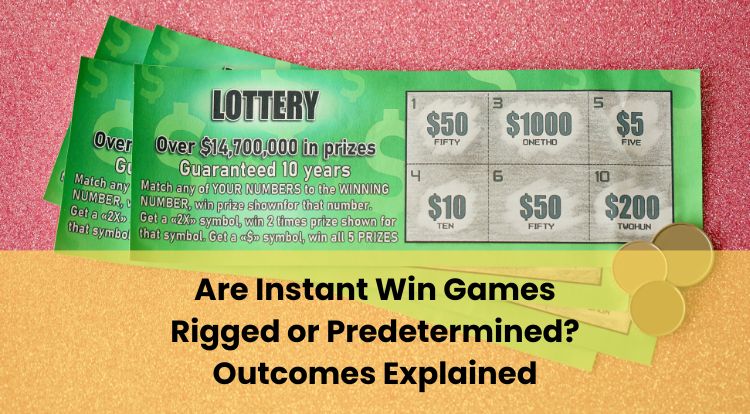
If you have ever played an instant win game online and wondered whether the result was already fixed, you are not alone. A run of no-wins or a story from a friend can leave anyone questioning how these games decide outcomes.
Instant win titles are quick, colourful and straight to the point. Behind the animations, though, there is a defined process that decides every result. This guide breaks that process down in plain English and sets out the protections in the UK that keep things fair.
If you want clear answers on how results are produced, what RTP really means, and how to check a game’s credentials, you are in the right place.
What Are Instant Win Games And How Do They Work?
Instant win games are online games that reveal the result straight away, usually after a single action. They often take the shape of digital scratch cards, match-and-reveal screens or simple pick games with bright visuals.
You choose your stake, start the round and the outcome appears within seconds. There is no waiting for a draw or event to finish. Each round is self-contained, so one play does not carry over to the next.
The design aims to be straightforward. The rules sit within the game screen, the prize table explains what combinations pay, and the software decides and displays the result immediately. The decision itself is handled by certified technology, which cannot be altered mid-play.
So if results appear the moment you press play, can an operator set them in advance to favour or disadvantage you?
Can Operators Predetermine Instant Win Results?
In the UK, the outcome of an online instant win round is fixed the moment you confirm your play. After that point, neither the operator nor its staff can step in and change what happens on your screen.
Games are built with software that decides results according to a defined prize model. In online formats this decision is produced by a certified system such as a Random Number Generator, or by drawing from a pre-approved prize table. Either approach is configured and tested before the game goes live, then checked again on an ongoing basis.
What operators cannot do is choose who wins on a round-by-round basis or tweak a result after you have staked. The frequency and size of prizes are set in the game’s mathematics and enforced by independent testing against UK standards.
To see what actually picks a result in the split second after you click, it helps to look at the engine behind most games: the RNG.
Random Number Generators And How Outcomes Are Produced
A Random Number Generator, or RNG, is software designed to produce results that cannot be predicted from one round to the next. When you start a round, the RNG selects a value from a very large range of possibilities. The game maps that value to a particular outcome, whether that is a prize amount or a non-winning result.
Each round is independent. What happened before does not influence the next selection, and there is no memory of your previous outcomes. That independence is crucial, because it prevents any hidden pattern from building up over time.
RNGs used in regulated games are evaluated by specialist testing firms. They verify that the selections are unbiased, that the mapping between numbers and outcomes matches the approved game design, and that the software behaves the same under repeated examination.
Once you know how results are picked, the next piece of the picture is how payouts are set over the long term.
Return To Player And How Payouts Are Set
Return to Player, shown as RTP, is the percentage of total stakes a game is designed to pay back over a long period. If a game advertises 95% RTP, it means that across a very large number of rounds taken together, about £95 of every £100 staked is returned as prizes.
RTP is not a prediction for any single session. One person can see several wins in a short spell, another can see few or none. The average only emerges over thousands or millions of rounds.
Developers decide the RTP and prize distribution when they build the game. That includes how often small, medium and larger prizes appear, sometimes called hit frequency and variance. Before launch, the claimed RTP is tested against the actual behaviour of the software, and that figure must also be shown in the game’s information area so players can make an informed choice.
Of course, figures and promises only matter if someone independent checks they are being met.
Are Instant Win Games Independently Audited And Regulated?
Yes. In the UK, instant win games sit within a licensing system backed by the Gambling Commission. A game cannot be offered unless it has passed independent testing to confirm it performs as approved. This covers the random number generation, the mapping of outcomes, the stated RTP and technical resilience.
Testing is not a one-off. Licensed operators are subject to ongoing audits, technical inspections and compliance checks. If a game update changes any part of the decision engine, it must be retested. Sites must also publish licensing details and keep records that allow regulators to verify performance over time.
Alongside technical fairness, licensed operators are required to provide clear information, secure handling of player data and tools that support safer play. Independent support services are signposted for anyone who wants advice or help.
Even with strong oversight, software can still encounter problems. So what happens if something goes wrong mid-round?
Can Technical Faults Or Tampering Affect Outcomes?
Technical faults can occur with any online product, and instant win games are no exception. If a round is interrupted or a display error occurs, operators follow documented rules set out in their terms. Common remedies include voiding the affected round and returning the stake, or recovering the correct result from secure logs and settling accordingly.
Tampering, meaning any attempt to unfairly change a result, is treated as a serious threat. Regulated sites use security controls, encryption and monitoring to protect systems. The underlying software is assessed for vulnerabilities, and any anomalies are investigated and reported under clear escalation procedures.
If you see a frozen result, a missing credit or a message that suggests an error, it is worth contacting the site with the time, game name and any screenshots. Licensed operators must look into technical complaints and explain what happened.
If you prefer to check a game’s credentials before you play, there are a few simple markers to look for.
How To Check If A Specific Instant Win Game Is Fair?
A legitimate site will display its Gambling Commission licence details in the footer, with a link to the public register. That register shows who runs the site, what activities they are licensed for and whether any sanctions have been applied.
Reputable operators also publish information about independent testing. You will often find a certificate or a reference to an approved testing house, along with a summary of what was checked. Inside the game, the help or information menu should show the RTP and explain how results are determined at a high level.
If any of this is missing, hard to find or inconsistent, treat it as a warning sign. You can always cross-check the operator’s name on the Gambling Commission register and ask customer support to point you to the relevant documents. Licensed sites are expected to respond clearly to fairness questions.
And if, after checking, you still feel something is not right, there is a formal route to escalate.
What To Do If You Suspect A Game Is Rigged?
If a result looks wrong, pause play and keep a record of what you saw. Note the time, game title and what happened on screen, and save any confirmation numbers or screenshots. Share these details with the site’s support team and ask for an investigation. They should review system logs and respond with a clear outcome.
If the reply does not address your concern, you can make a formal complaint through the operator’s process. When that stage is complete, unresolved disputes can be taken to the site’s Alternative Dispute Resolution provider, which is an independent body assigned to handle gambling complaints.
You can also report concerns to the Gambling Commission through its public channels. While it will not usually resolve individual cases, it uses reports to monitor compliance and can require corrective action where standards are not being met.
Taken together, this framework means instant win games on licensed UK sites are decided by certified systems, checked by independent experts and backed by clear complaint routes, so you can see how results are produced and what to do if something does not add up.
**The information provided in this blog is intended for educational purposes and should not be construed as betting advice or a guarantee of success. Always gamble responsibly.